[Click here for printer-friendly version]
The American Blackbelly (AB) sheep is a hair sheep having specific traits and a phenotype that is consistent with its principal ancestor, the Barbados Blackbelly sheep. It has been developed through a variety of crosses over a number of years, leading to both genetic diversity and variations in appearance. In an effort to update the breed standards to facilitate their book of registry, the Barbados Blackbelly Sheep Association International (BBSAI) established a committee of its members familiar with the AB breed, who in turn surveyed other known breeders of AB sheep to determine what phenotypic traits were most desirable.
The traits listed below describe the American Blackbelly breed recognized by the BBSAI and should be used to evaluate sheep considered for registration with the BBSAI. Although this standard describes the phenotypic attributes of the breed, there are other attributes that are not easily defined or quantified but that are the most valued about the American Blackbelly breed. Attributes such as prolificacy, disease resistance, parasite tolerance, non-seasonal breeding, and mothering ability contribute greatly to the value and integrity of the breed. The BBSAI encourages and expects breeders to include these non-phenotypic attributes when evaluating and selecting stock to include in their breeding programs.
The BBSAI does not guarantee the quality of a registered sheep. The purpose of the BBSAI registry is to enable breeders to track the pedigrees of their animals. It is the breeder’s responsibility to ensure that only sheep meeting these breed standards are submitted for registration. It is also the breeder’s responsibility to cull any sheep that are Not to Standard and to prevent their genetics from contaminating the general population of American Blackbelly sheep.
These are the tiers used to describe each attribute:
- Ideal : The perfect sheep. This is the sheep we all want, the sheep we all strive to breed.
- Acceptable : These variations or slight flaws are generally cosmetic and rarely are genetically fixed across generations. If a flaw does persist across generations, the breeder should work to eliminate it.
- Discouraged : These are serious flaws. The breeder should recognize that these flaws, if allowed to pervade the flock, will compromise the flock’s integrity. Elimination of these flaws should be a priority.
- Not to Standard : Sheep with these flaws should be culled from a breeding program. These flaws are considered detrimental to the future of the breed and disqualify animals for registration with the BBSAI.
Flaws due to a documented injury are not usually considered disqualifying.
Head
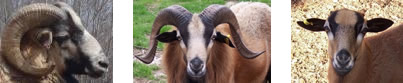
Ideal: The shape of the head is triangular with a straight nose line in ewes and young males. Rams develop a “Roman” nose as they age and/or in response to sparring; the head of the ram should be distinctly masculine with a prominent Roman nose in adults; the head of the ewe should appear more feminine without a Roman nose; the muzzle is wide and strong with firm lips. Incisor teeth should meet the dental pad (no “off-bite”).
Acceptable: Lack of a prominent Roman nose in males; the ewe’s head may exhibit some less feminine coarseness (i.e., slight roman nose, etc.), but it must still be decidedly distinct from the ram’s head.
Discouraged: Muzzle more narrow or more wide than ideal, mild off-bite.
Not to Standard: Overshot or undershot jaw, severe off-bite, congenital deformities of the head, wattles on the jaw or neck.
Ears
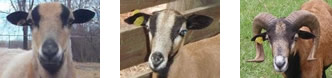
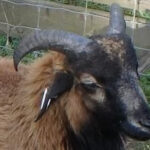
Ideal: The ears are pointed and when alert stick out from the side of the head parallel to the ground; the ear length should be approximately one-half the width of the animal’s skull at the widest point of the skull (~3 to 5 inches); some variation in the size of the ears is permitted. The inside of the ears should be black.
Acceptable: Ears pointing slightly forward or slightly upward (
Discouraged: Adults with floppy ears, overly long ears or half ears or less (“elf” ears), ears not parallel to ground.
Not to Standard: Ears pointing upward or downward more than 45 degrees from parallel to the ground, no ears.
Eyes
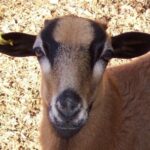
Ideal: The eyes should be bright and alert and are almond shaped, the irises of the eyes can be any shade of brown or golden brown, white sclera not visible.
Discouraged: Eyes of a color other than brown or golden brown, white sclera showing.
Not to Standard: Inverted eyelids or other congenital abnormalities of the eyes or eyelids or blindness.
Poll and Horns

The major trait distinguishing the American Blackbelly from the Barbados Blackbelly are the horns. Likewise, the distinctive Blackbelly pattern distinguishes the American Blackbelly from other horned hair sheep. The horns may be of several shapes, but primarily two, commonly referred to as a “tight curl” that curves slightly inward and stays close to the head and face; and a “wide curl” spiraling out from the head and face. Regardless of shape or size, the horns should be well balanced on the head and symmetrical (i.e., each horn should extend an equal distance from the centerline of the face and be of equal length). Horns may be “webbed” but not branching nor should there be more, or less, than one horn on each side of the head.
Ideal: Rams should exhibit good horn growth (~1″/month for the first 2 years), horns should be well balanced on the head and symmetrical. Ewes should be polled (no horns).
Acceptable: Loose scurs or short horns are acceptable on mature ewes. Mild asymmetry of horns on rams (<10% difference in distance from centerline and length) is acceptable.
Discouraged: Horns over 3″ on ewes. More than mild asymmetry of horns on rams.
Not to Standard: Rams with scurs or stunted horn growth, severely asymmetrical horns, more than or less than two horns, or horns that interfere with the wellbeing of the animal (i.e., touching or rubbing the head, neck or face.)
Neck
Ideal: The neck should be strong and muscular (rams more so than ewes), proportional to body size, clean cut, and without loose folds of skin. Rams should have prominent mane and ewes may or may not have a short mane.
Acceptable: Slightly short or long necks.
Discouraged: A thin, scrawny neck or overly long or extremely short neck.
Not to Standard: Wattles, congenital deformities of the neck shape or structure.
Forequarters
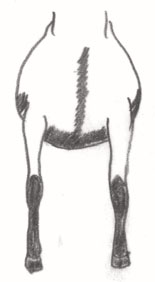
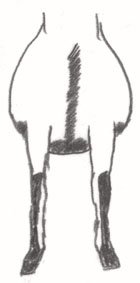
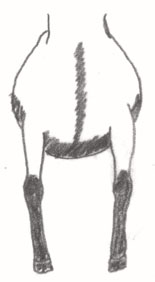
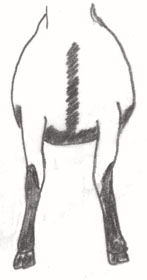
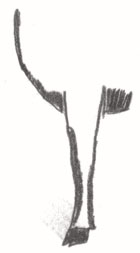
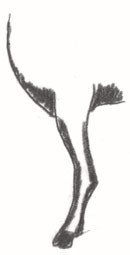
Ideal: The arm and the shoulder blade are well muscled, the forelegs appear straight when viewed from the front and side, the pasterns are strong and springy.
Discouraged: Weak, bony shoulder blades that protrude from the body, deviations from straight legs as long as they are minor, including such things as weak pasterns, feet that are pigeon-toed, and knees that are knock-kneed, calf-kneed, or buck-kneed.
Not to Standard: Marked deviations from ideal, including but not limited to deviations that interfere with the sheep’s ability to walk normally.
 |
 |
 |
 |
 |
 |
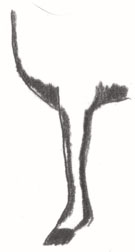 |
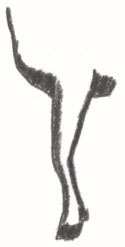 |
| Correct | Splay- Footed |
Pigeon Toed |
Knock- Kneed |
Correct | Calf- Kneed |
Weak Pasterns |
Buck- Kneed |
Hindquarters
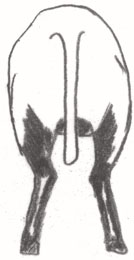
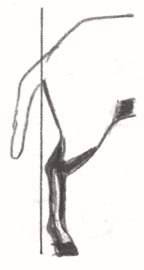
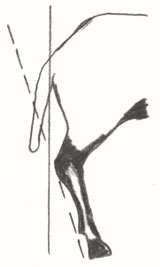
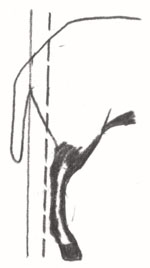
Ideal: The hindquarters should be muscular with a long, gradually sloping croup (rump), the hind legs viewed from behind should be straight, from the side view, a vertical line dropped from the posterior of the buttocks should hit the point of the hock and the back of the ankle and contact the ground 1 in. to 2 in. behind the heel.
Acceptable: A slight tendency toward cow-hockedness is not uncommon (when viewed from behind, the ‘back knee’ or hock is set inward, resulting in a splayed look in the back legs).
Discouraged: Moderate deviations from ideal for bowed legs; sickle-hocked legs; and post-leggedness.
Not to Standard: Marked deviations from ideal, including but not limited to deviations that interfere with the sheep’s ability to walk normally.
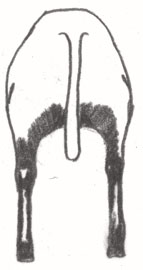 |
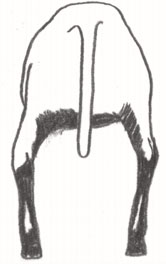 |
 |
 |
 |
 |
| Correct | Bowlegged | Cow- Hocked |
Correct | Sickle- Hocked |
Post- Legged |
Feet
Ideal: The hooves are cloven, black, and clean-edged with shiny smooth surfaces.
Discouraged: Hooves with small white marks on them.
Not to Standard: White hooves, uncloven hooves, or marked deviations from ideal, including but not limited to deviations that interfere with the sheep’s ability to walk normally.
Body
Ideal: Body capacity should be relatively large in relation to the size of the animal, the body should be longer than tall, deep and wide with well-sprung ribs. A mature ram’s testicles should be well developed and symmetrical. A mature ewe should have a well-developed, symmetrical udder with two teats.
Discouraged: Asymmetrical testes in rams; ewes with an asymmetrical udder or udder with more than two teats.
Not to Standard: Dwarfism (stunted growth, abnormal body proportions), congenital deformities (crooked spine, etc.), cryptorchidism (a condition in which one or both testes fail to descend normally) in a ram, ewe with an udder having less than two teats.
Topline
Ideal: The withers are higher than and sloping into a level back, the loin viewed from the top should be broad and strong, the croup (rump) should be long and gradually sloping.
Discouraged : Saddle back or sway back; short, steep croup
Tail
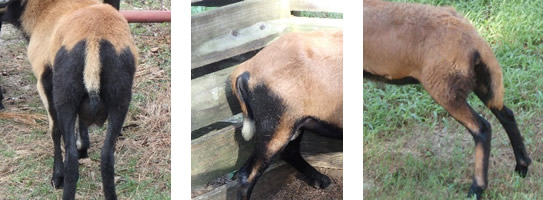
Ideal: The tail should not be docked and should reach from halfway to all the way to the hock, and following a continuous line down from the croup without any crookedness. The tail should be black on the underside and match the overall coat color on the topside.
Acceptable: Slightly shorter than ideal length, topside color on the tail varies from coat color, tail has a black or white tip (<1.5").
Discouraged: Short tails (< halfway to hock), crooked tails.
Not to Standard: No tail, docked tail, overly long tail (reaching past the hock).
Coat

Ideal: The coat consists of medium to thick coarse hair that lies flat against the skin; an adult ram should have a mane of coarse black hair that covers the neck and downward to the chest; the hair coat contains sufficient lanolin to help shed water and repel ticks and other ectoparasites. No wool present at any time in warm climates. In cold climates the presence of winter wool that completely sheds each year may be considered ideal.
Acceptable: A woolly “baby coat” often seen in lambs that does not shed the first summer but does shed thereafter; a winter wool undercoat that completely sheds each year.
Discouraged: Small patches of wool along the topline and rear legs that do not shed from year to year.
Not to Standard: A woolly coat that is not shed and that requires shearing.
Color and Markings
Just as the major trait distinguishing the American Blackbelly from the Barbados Blackbelly are the horns, the distinctive Blackbelly pattern and badger face distinguishes the American Blackbelly from other horned hair sheep. Due to the number of various out-crossings of the Barbados Blackbelly to horned sheep, the color of the coat can vary from light fawn to dark mahogany, but the “blackbelly pattern” should always be apparent. This pattern starts with the distinct badger face markings and includes black extending from the lower jaw down the neck, covering the abdomen and inside of the legs, and extending along the underside of the tail.
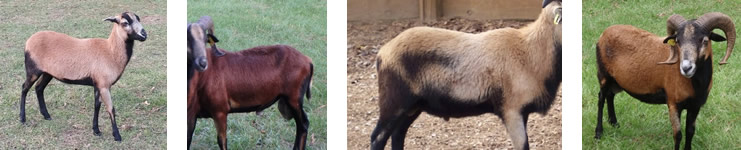
Ideal: The blackbelly pattern is clear, distinct and prominent with clean demarcation between the black markings and the coat color; body colors are limited to black and various shades of brown (which can vary from light fawn to brown to mahogany).
Acceptable: A less prominent, but still distinct, blackbelly pattern; contrasting colors may have faded edges, dark “hip patches” and dark or light “saddle patches”.
Discouraged: Blackbelly pattern is obscured or indistinct due to dark coat color, splotching or light underside markings.
Not to Standard: Blackbelly pattern is absent (i.e., a sheep that is completely brown, tan, red, black or white or a mixture of colors); body color includes pure white color, excepting the tip of tail (this does not refer to lighter shades of grey or cream commonly seen on the face or tail).
Color and Markings: Head, Face and Neck
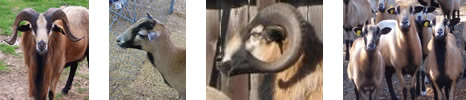
The badger-face markings are a key characteristic of both the American Blackbelly and the Barbados Blackbelly from which the breed was derived. The distinct pattern consists of black markings on the crown of the head, primary facial bars or “barbs” that extend from the crown (base of horns on rams) down the face above the eyes terminating just below the inside corner of the eye. These barbs may continue down the side of the face to connect with the black lower jaw. Secondary facial bars extending from the outside corner of the eye and connecting with the corner of the mouth or lower jaw may also be present. The inside of the ears is black. The remaining areas of the head and face should closely match the body coat color or be of a lighter shade. There should be a continuous black neck stripe connecting the lower jaw with the black belly.
Ideal: The badger-face pattern is clear and distinct with clean, sharply contrasting black markings and face color; barbs terminate just past the eye; colors are limited to black and various shades of the primary coat color (which can vary from light fawn to brown to mahogany); there is a wide continuous black neck stripe.
Acceptable: A less prominent, but still distinct, badger-face pattern; contrasting colors may have faded edges; the crown matches the coat color (not black); the primary facial barb may extend to the jaw and secondary facial barbs may be present; lower jaw is brown; non-continuous neck stripe.
Discouraged: Badger-face pattern is obscured or indistinct due to dark underlying facial coloring; absence of a neck stripe.
Not to Standard: Badger-face pattern is absent (i.e., there is either no facial barring or the barring is indistinguishable from the underlying facial color).
Size
Because the American Blackbelly breed was developed from the Barbados Blackbelly, a tropical species, it has historically been of small body size resembling a deer. However, since the range of the breed has been extended well beyond the tropics, and there has been a desire for larger carcass size, body size and weight may vary considerably. Larger body size and weight are generally preferrable in colder climates or where meat is the intended market, while the smaller sizes may be preferred in warmer climates The body is generally longer than tall and mature rams will be 30-32 inches tall at the withers and ewes 24-28 inches.
Ideal: The American Blackbelly is generally a slow growing breed, and sheep may not reach ideal weight until about 2 years of age. At that time, rams should weigh between 100 and 160 lbs, and ewes should weigh between 70 and 120 lbs.
Acceptable: Sheep older than 2 years who weigh more than the maximum ideal weight, providing that their weight is proportionate to the size of their body frame and they are not obese.
Discouraged: Sheep older than 2 years who weigh less than the minimum ideal weight.
Not to Standard: Sheep with obviously stunted growth, dwarfism.
Copyright © 2021 BBSAI. All Rights Reserved.